Introduction
As a small business owner, choosing the right business entity is one of the most profitable decisions you will ever make. Specifically, electing S-Corporation status can save you thousands of dollars a year in self-employment taxes. However, it is not the right move for everyone.
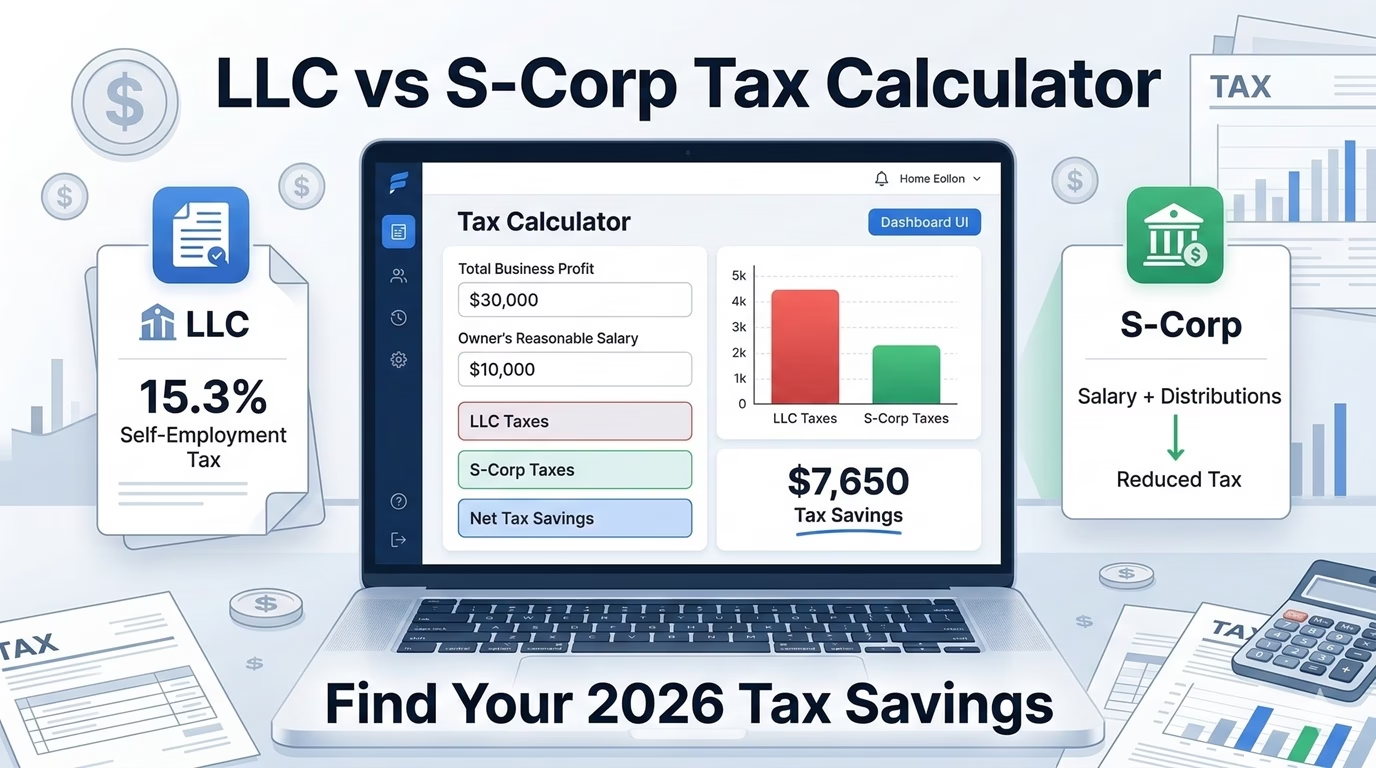
If you convert too early, the costs of running payroll and filing a corporate tax return can outweigh the benefits. Therefore, we built this free LLC vs S-Corp Tax Calculator to help you determine exactly when to make the switch in 2026.
LLC vs. S-Corp Tax Savings
(Inputs needed: Total Business Profit, Owner’s Reasonable Salary. Outputs: LLC Taxes, S-Corp Taxes, Net Savings).
How the LLC vs S-Corp Tax Calculator Works
To understand the results of the calculator, you need to understand how the IRS taxes these two different business structures. First, let us look at the standard Limited Liability Company (LLC).
The LLC Self-Employment Tax Trap
By default, the IRS taxes a single-member LLC as a sole proprietorship. This means all of your net business profit passes through to your personal tax return. Consequently, you must pay a 15.3% self-employment tax (Medicare and Social Security) on every single dollar of profit, in addition to your standard income tax.
For a deeper dive into standard LLC deductions, read our comprehensive LLC Tax Guide 2026.
The S-Corp Advantage
When you elect S-Corp status, you split your business profit into two categories:
- A W-2 Salary: You must pay yourself a “reasonable salary.” You will pay the 15.3% tax on this amount.
- Owner Distributions: The remaining profit is paid out as a distribution. Crucially, distributions are exempt from the 15.3% self-employment tax.
The Tax Savings Formula
Our calculator uses the standard IRS self-employment tax rate to find your savings. The math behind the S-Corp savings looks like this:
$$\text{Tax Savings} = (\text{Total Profit} – \text{Reasonable Salary}) \times 0.153$$
For example, if your business makes $100,000 in profit and you take a W-2 salary of $50,000, you save the 15.3% tax on the remaining $50,000. That is an immediate savings of $7,650!
Avoid These Common Mistakes in 2026
While the tax savings look great, many business owners rush into this election and end up losing money. Furthermore, the IRS actively audits S-Corps that fail to follow compliance rules.
Before making the jump, avoid these critical errors:
- Skipping Payroll: As an S-Corp, you are legally required to run official payroll. You cannot just write yourself a check. We highly recommend comparing Gusto vs ADP Payroll 2026 to automate this process.
- Taking a $0 Salary: Trying to avoid all self-employment tax by taking zero salary is an immediate audit trigger. Always pay yourself a fair market wage. To learn more about entity errors, check out our guide on LLC vs S-Corp Tax Mistakes.
Maximize Your Savings with Other Loopholes
Once your S-Corp is set up, you can stack other advanced tax strategies to bring your taxable income down even further. For instance, many of our clients combine their S-Corp structure with the Augusta Rule Tax Loophole to rent their personal home to their business tax-free for up to 14 days a year.
In addition, if you have children, you can utilize the Hire Your Kids Tax Loophole to shift income into a lower tax bracket.
Conclusion
Knowing your numbers is the key to financial freedom. Play with the calculator above to see your exact break-even point. If your projected tax savings exceed the cost of bookkeeping and payroll, 2026 might be the perfect year to make the S-Corp election.