Introduction
If you own rental property, the difference between a “Repair” and an “Improvement” is the difference between a huge tax refund and a surprise bill.
Here is the scenario: You spend $4,000 replacing a broken HVAC unit in your rental.
- If it’s a “Repair”: You deduct the full $4,000 from your taxes this year.
- If it’s an “Improvement”: You have to spread that deduction over 27.5 years (about $145/year).
For 2026, the rules have changed again. The De Minimis Safe Harbor limit is firm at $2,500, and the 100% Bonus Depreciation rule has been miraculously restored.
In this guide, we break down the IRS “Safe Harbors” that allow savvy landlords to write off thousands in renovations immediately.
1. The “De Minimis” Safe Harbor (The $2,500 Rule)
This is the first loophole every landlord must know. The IRS allows you to automatically deduct any expense that costs $2,500 or less per invoice.
How it works:
- Scenario A: You buy 10 new fridges for an apartment complex at $800 each. Total bill: $8,000.
- Result: Since each item is under $2,500, you can deduct the full $8,000 immediately.
- Scenario B: You pay a contractor $4,000 to replace a roof patch.
- Result: Since it is over $2,500, you might have to depreciate it—unless it qualifies as a “Repair” (see below).
⚠️ The Audit Trap: To use this rule, you must file a specific “Election Statement” with your tax return every single year. Software like Stessa or TurboTax handles this for you. 👉 Related: Best Accounting Software for Landlords (Stessa vs. QuickBooks)
2. Repairs vs. Improvements (The BAR Test)
If an expense is over $2,500, you must determine if it is a “Repair” (Deductible) or an “Improvement” (Depreciable). The IRS uses the BAR Test.
It is an IMPROVEMENT if it:
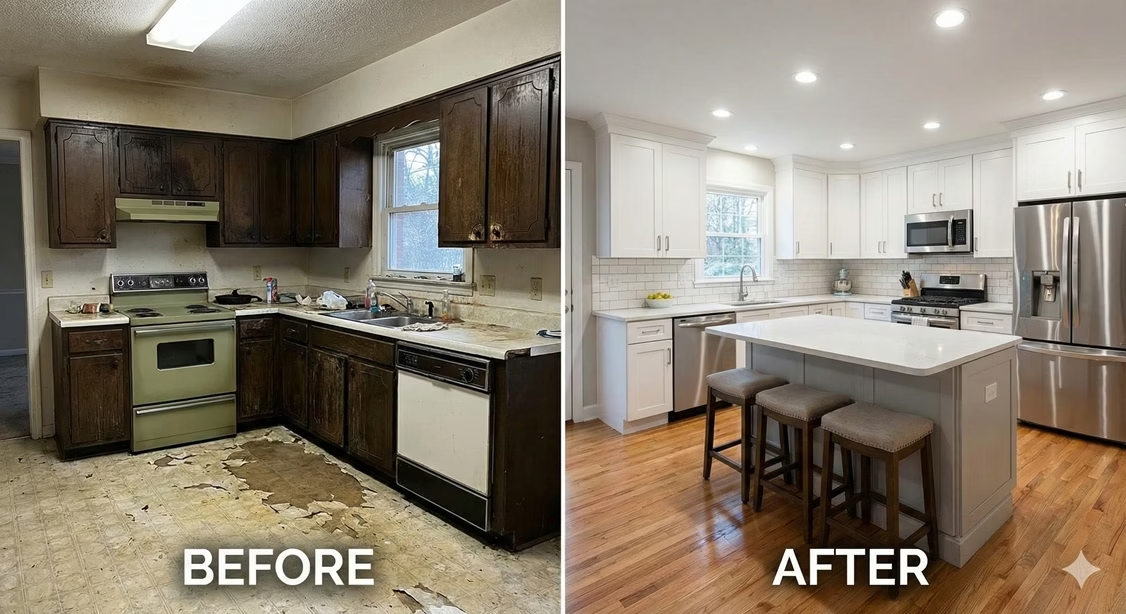
- Betterment: Does it make the property better than it was before? (e.g., Replacing laminate counters with granite).
- Adaptation: Does it change the use of the property? (e.g., Turning a garage into an Airbnb).
- Restoration: Does it restore a property that was in total disrepair? (e.g., Gutting a house you just bought).
It is a REPAIR if it:
- Returns the property to its original condition (e.g., Fixing a leak, patching a roof, repainting a room).
3. Breaking News: 100% Bonus Depreciation Restored for 2026
This is the biggest tax news of the year. Under the previous law, “Bonus Depreciation” was supposed to drop to 20% in 2026. However, the new “One Big Beautiful Bill Act” (passed late 2025) has restored it to 100%.
What this means for you: If you buy “Qualified Property” (like appliances, carpet, or fences) in 2026, you can deduct 100% of the cost immediately—even if it costs more than $2,500.
- Example: You spend $15,000 on new carpet for an apartment building.
- Old Rule (2025): You could only deduct $6,000 (40%).
- New Rule (2026): You can deduct the full $15,000.
4. The “Routine Maintenance” Safe Harbor
Here is another hidden gem. You can deduct expensive repairs (even over $2,500) if you expect to perform them more than once every 10 years.
- Example: Refinishing hardwood floors.
- If you expect to do this every 5–7 years, it is “Routine Maintenance,” and you can write it off immediately.
5. Section 179 (For Commercial Landlords)
For 2026, the Section 179 limit has increased to $2.56 million. While Section 179 generally doesn’t apply to “Residential Rental Property” (like houses), it does apply to specific improvements for commercial buildings and Short-Term Rentals (Airbnbs), such as:
- Roofs.
- HVAC Systems.
- Fire Alarms.
Conclusion: How to Audit-Proof Your Deductions
The IRS loves to audit “Repairs” because it is a gray area. The only way to win an audit is with perfect documentation.
You cannot just show a credit card statement saying “Home Depot – $4,000.” You need the actual receipt showing exactly what materials were bought.
Your 2026 Strategy:
- Use specific software to scan receipts instantly.
- Separate your funds so personal expenses don’t mix with repairs.
- File the elections for the “De Minimis” Safe Harbor.
👉 See the Top 3 Tools to Automate This (Stessa vs. Baselane)