Introduction
The restaurant business is brutal.
The average profit margin is just 3% to 5%.
That means for every $100 customer check, you keep $5. If a server breaks a glass or a cook burns a steak, that profit is gone.
In 2026, the game has changed. Food costs are up 4.6%, labor is more expensive than ever, and the IRS has introduced massive changes to how tips are taxed and reported.
If you are still running your books on a napkin or looking at “Food Cost” once a month, you are flying blind.
In this comprehensive guide, we break down the financial pillars of running a profitable restaurant in 2026: from the “No Tax on Tips” rule to the “Prime Cost” formula that saves failing bars.
Part 1: The New 2026 Tax Rules (“No Tax on Tips”)
The biggest headline this year is the One Big Beautiful Bill Act.
For your staff, it’s a huge win: they can deduct up to $25,000 of tips from their federal taxes.
For you (the owner), it’s a compliance minefield.
The W-2 Update:
You must now report tips using specific “Occupation Codes” on W-2 forms. If you get this wrong, your staff loses their deduction, and you face an audit.
The Employer Win (FICA Credit):
Don’t forget the 45B Credit. The IRS gives you a dollar-for-dollar tax credit for the Social Security and Medicare taxes you pay on employee tips. This can save you thousands.
👉 Read the full breakdown: The Restaurant Tax Guide 2026
Part 2: Prime Cost (The 60% Rule)
Stop looking at just “Food Cost.” It’s an outdated metric.
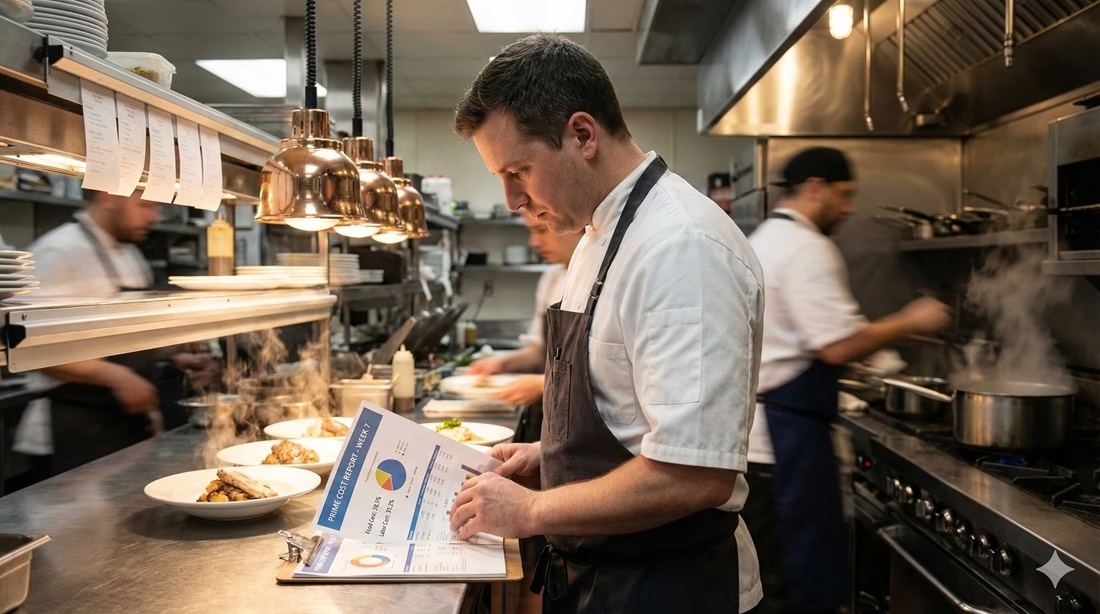
You must track Prime Cost.
The Formula:
$$\text{Total COGS} + \text{Total Labor} = \text{Prime Cost}$$
The 2026 Benchmark:
- Target: 55% – 60% of Total Sales.
- Danger Zone: Anything over 65%.
If your Prime Cost is 65%, you are working for free. You need to either raise menu prices or cut labor hours immediately.
To fix this, you need to track Actual vs. Theoretical food usage.
👉 Deep Dive: Restaurant Inventory Management Guide
Part 3: The Tech Stack (POS & Handhelds)
In 2026, a Point of Sale (POS) is your inventory manager and payroll clerk.
The trend this year is Handhelds.
Why switch to Handhelds?
- Table Turn: Servers take orders and payments at the table, turning tables 15-20% faster.
- Compliance: Modern systems like Toast and Square automatically handle the new “Tip Occupation Codes” for W-2s.
The Standard Stack:
- POS: Toast (Full Service) or Square (QSR).
- Inventory: MarketMan or MarginEdge (to track waste).
- Scheduling: 7shifts (to control labor cost).
👉 Review: Best Restaurant POS Systems (Toast vs. Square)
Part 4: Menu Engineering (Psychology)
You can’t just raise prices across the board. You have to “Engineer” your menu.
Categorize your dishes into four buckets:
- Stars: High Profit, High Popularity. (Keep these).
- Plowhorses: Low Profit, High Popularity. (Raise the price slightly).
- Puzzles: High Profit, Low Popularity. (Re-market them or change the description).
- Dogs: Low Profit, Low Popularity. (Kill them immediately).
The 2026 Strategy:
Focus on your “Plowhorses.” If you sell 500 burgers a week (low margin), raising the price by just $0.50 adds $13,000 to your bottom line purely in profit.
Part 5: Labor Laws (The “Tip Credit” Phase-Out)
Be aware of local changes.
If you operate in DC, Chicago, or California, the “Tip Credit” (paying servers sub-minimum wage) is vanishing.
- The Impact: You may have to pay servers the full $17+ minimum wage.
- The Pivot: Many restaurants are switching to a “Service Charge Model” (20% auto-grat).
- The Warning: Service charges are NOT eligible for the “No Tax on Tips” deduction.
Conclusion: Operations Over Everything
A restaurant with great food but bad accounting will fail. A restaurant with average food but great accounting can scale.
In 2026, your survival depends on your ability to track Prime Cost weekly and navigate the new tax laws.
Your Action Plan:
- Audit your W-2s. Are you ready for the new Occupation Codes?
- Calculate Prime Cost. Is it under 60%?
- Upgrade your POS. Get handhelds to speed up service.