
Introduction
You finally did it. You quit your job, started an LLC, and made $100,000 in profit this year.
You feel rich—until your CPA hands you your tax bill. Not only do you owe standard federal and state income taxes, but you are also hit with a massive, gut-wrenching bill for something called the Self-Employment (SE) Tax.
Most new business owners have no idea that simply operating as a standard LLC costs them an extra 15.3% on every dollar they earn.
But the wealthy don’t pay this tax on all their income. They use a simple, one-page IRS form to change how their LLC is taxed, legally bypassing thousands of dollars in taxes. Here is the difference between a default LLC and an S-Corp, and the exact math that proves why staying a regular LLC might be the most expensive mistake you make in 2026.
1. The “Default LLC” Trap
When you register an LLC with your state, the IRS doesn’t actually know what to do with you. By default, they tax you as a “Disregarded Entity” (Sole Proprietor).
Here is why that hurts: When you are a regular W-2 employee, you pay 7.65% in payroll taxes (Social Security and Medicare), and your employer pays the other 7.65%. But when you are a default LLC, you are both the employee and the employer. The IRS makes you pay both halves.
That is a 15.3% tax on your entire net profit, right off the top, before you even pay regular income tax.
- Make $100,000? You owe **$15,300** just in SE tax. Ouch.
2. The S-Corp Secret (How the Rich Split Their Money)
You don’t need to form a brand new company. You can keep your existing LLC and simply file IRS Form 2553 to tell the government: “I want my LLC to be taxed as an S-Corporation.”
When you become an S-Corp, the rules of the game change entirely. You are no longer just the “owner.” You become an Employee and a Shareholder.
This allows you to split your $100,000 profit into two buckets:
- W-2 Salary (Employee Bucket): You must pay yourself a “Reasonable Salary.” This bucket is subject to the 15.3% payroll tax.
- Owner’s Distribution (Shareholder Bucket): The leftover profit is taken as a distribution. This bucket is 100% EXEMPT from the 15.3% Self-Employment tax.
3. The Math: How to Save $8,000 – $10,000 Instantly
Let’s look at two identical business owners in 2026. Both made $100,000 in net profit.
Owner A: The Default LLC
- Total Profit: $100,000
- Subject to 15.3% SE Tax: All $100,000
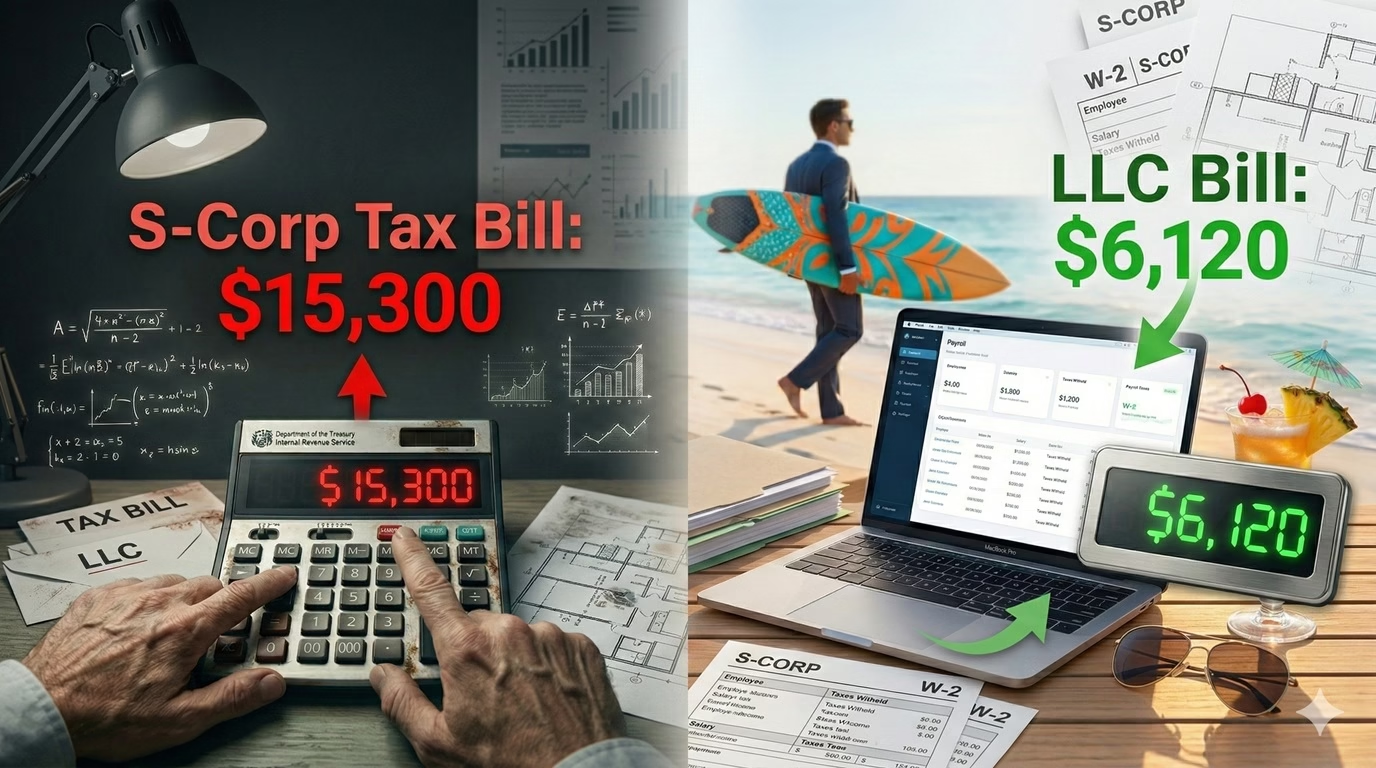
- SE Tax Bill: $15,300
Owner B: The S-Corp Hack
- Total Profit: $100,000
- They put themselves on a W-2 payroll for a “Reasonable Salary” of $40,000.
- They take the remaining $60,000 as an Owner’s Distribution.
- Subject to 15.3% SE Tax: Only the $40,000 salary.
- SE Tax Bill: $6,120
By simply filing one form and running payroll, Owner B just saved $9,180 in cash. They put that money straight into their pocket instead of handing it to the IRS.
4. The IRS “Reasonable Compensation” Trap
If distributions are tax-free from the 15.3% SE tax, why not just pay yourself a $1 salary and take $99,999 as a distribution?
Do not do this. The IRS isn’t stupid. The law requires S-Corp owners to pay themselves “Reasonable Compensation” for the work they do before taking any distributions.
If you are a freelance graphic designer making $100,000, what would it cost to hire a stranger to do your exact job? Probably around $40,000 to $60,000. That is your “Reasonable Salary.”
If you take a $0 or $10,000 salary, the IRS will audit you, reclassify all your distributions as salary, and hit you with massive back-taxes and penalties.
5. When Should You Switch? (The $60k Rule)
An S-Corp is not for everyone. Running an S-Corp requires you to pay for payroll software (like Gusto) and usually higher CPA fees for a dedicated corporate tax return (Form 1120-S).
The Golden Rule for 2026: Do not elect S-Corp status until your business is consistently generating at least $60,000 to $80,000 in net profit per year. Below that number, the accounting fees will eat up your tax savings.
Once you cross that $80,000 threshold, staying a default LLC is essentially setting your own money on fire.
Conclusion: Stop Tipping the IRS
You started a business to gain financial freedom, not to work 60 hours a week just to hand 15.3% of your profit back to the government before income taxes even apply.
Your Action Plan:
- Check your net profit for last year. Did you cross $80,000?
- If yes, talk to your CPA about filing Form 2553 (The deadline is usually March 15th for the current tax year!).
- Set up a payroll provider to start running your “Reasonable Salary.”
Want to learn another way to siphon tax-free cash out of your business? 👉 Read Next: The Augusta Rule: How to Rent Your House to Yourself Tax-Free